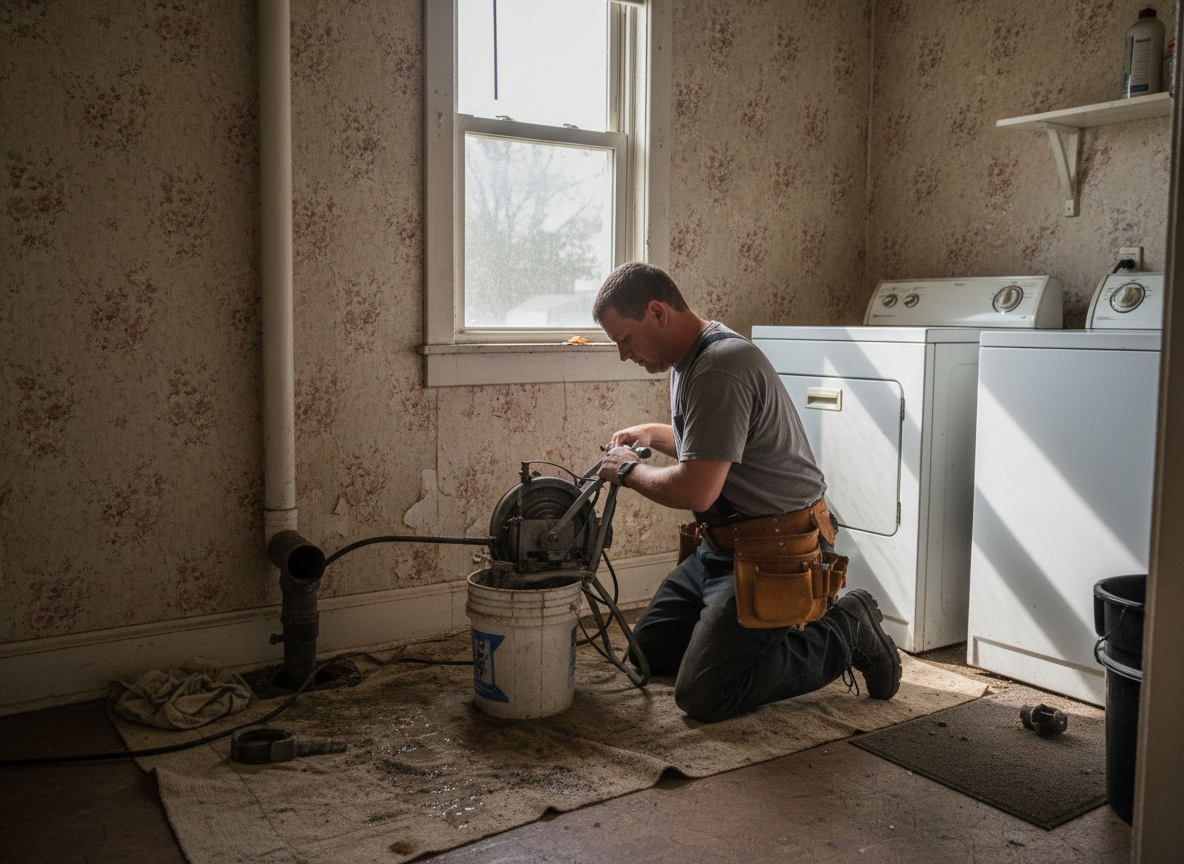
Laundry drains in Lorain homes often clog from accumulated hair, lint, detergent residue and grease that builds up inside standpipes and P-traps. Older brick and frame houses in South Lorain and Lakeview commonly have floor drains tied into clay tile laterals that sag or collect debris over decades. Lake Erie’s humid continental climate brings lake-effect snow and repeated freeze-thaw cycles that shift soil around Broadway and Oberlin Avenue properties, creating belly sections where water pools and solids settle.
Technicians begin by running a sewer camera through the cleanout or laundry standpipe to locate the restriction without unnecessary wall or floor demolition. Cable machines with cutting heads break through hair and lint masses while hydro jetting scours the pipe walls on cast-iron or clay sections common beneath Charleston Village homes. Access points near the Black River or I-90 corridors are chosen to reach the blockage while protecting mature street tree roots that frequently intrude into nearby laterals.
Basement floor drains connected to laundry lines in Downtown Lorain and Elyria properties can back up during spring thaw when snowmelt overwhelms the system. Gurgling at the washing machine or sewer gas odors from the vent stack signal partial blockages that worsen with repeated use. Clearing restores flow without replacing entire lines, preserving the original plumbing in homes built before modern PVC became standard.
Technician insight
In Lorain, the thing that catches most people out with Laundry Drain Cleaning is how freeze-thaw movement around the Black River shifts older clay laterals into bellies right where the washing machine line ties in. Homeowners often try plunging the standpipe first and push the lint farther into the sag instead of pulling it out. Once that happens we have to jet from the street cleanout on Broadway or Oberlin rather than working from inside the basement.
South Lorain Basement Backup
A homeowner in South Lorain noticed slow draining after every load and occasional gurgling at the laundry sink. Camera inspection showed a lint and hair mass lodged in a sagged clay section where the standpipe met the main lateral. Cable extraction followed by jetting restored flow, and the line was left clear without excavation.
Laundry Drain Cleaning Services We Offer
✓Laundry Standpipe Clearing
Removes compacted lint and detergent buildup inside vertical standpipes that connect washing machines to the main drain line.
✓Washing Machine P-Trap Service
Opens and cleans the curved trap beneath the machine to stop slow drainage and prevent water from backing into the appliance.
✓Floor Drain Connection Cleaning
Clears debris where laundry discharge meets basement floor drains, restoring proper flow in older homes with combined lines.
✓Vent Stack Inspection
Checks the roof vent serving laundry drains for obstructions that cause gurgling and slow emptying after wash cycles.
✓Hair and Lint Auger Extraction
Uses specialized cable heads to pull out tangled hair and fabric fibers that standard plungers cannot reach in horizontal runs.
How it works
- 1
Locate the Access Point
Identify the nearest cleanout or standpipe opening in the basement or utility area to reach the laundry drain line without cutting walls.
- 2
Camera Inspection
Insert a sewer camera to view the clog location, pipe material and any root intrusion or sags in the clay or cast-iron sections.
- 3
Mechanical Clearing
Run the appropriate auger or jetting head through the line to break apart and flush the hair, lint and grease accumulation.
- 4
Flow Verification
Run water from the washing machine and check all connected fixtures to confirm full drainage and no remaining odors.
Pricing
Cost depends on the clog location, access to the line and condition of the existing clay or cast-iron piping.